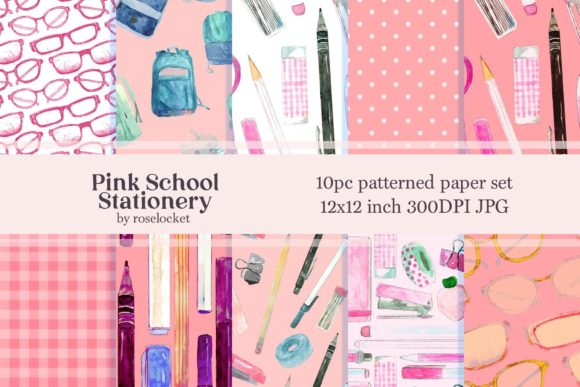
Pink School Stationery Digital Papers
In the modern creative ecosystem, the line between personal expression and professional output is increasingly blurred. Whether you are a teacher designing a homeschool curriculum, a small business owner creating branded materials, or a digital artist assembling a portfolio, the quality of your visual assets dictates the perceived value of your final product. Pink School Stationery Digital Papers represents more than just a collection of decorative backgrounds; it serves as a foundational resource for streamlining design workflows and adding a cohesive aesthetic to diverse projects.
This listing offers a curated set of 10 back-to-school themed seamless patterns, hand-drawn with specific attention to detail. The collection features school supplies, neon backpacks, and essential stationery items like pencils, pens, erasers, and tape. Visually, the set is defined by bright, sweet shades of pink accented with pops of neon and decorative backdrops. For professionals and hobbyists alike, these 3600x3600 pixel JPG files at 300 dpi provide the resolution necessary for high-quality printing and crisp digital rendering.
Integrating Digital Assets into Creative Workflows
Effective project management in design requires the right tools at the right time. Before opening a vector program or starting a physical craft project, the preparation phase often involves sourcing high-resolution textures and patterns. Using Pink School Stationery Digital Papers during this pre-production stage eliminates the need for time-consuming illustration from scratch. Instead of spending hours sketching a pencil motif or selecting a color palette that matches a specific brand identity, creators can immediately apply these hand-drawn elements to their canvas.
The transition from concept to execution becomes significantly faster when working with seamless patterns. Because these papers are designed to tile perfectly, they allow for rapid background creation. In a workflow context, this means you can generate full-page layouts for planners, book covers, or website headers in minutes rather than hours. This efficiency is crucial for freelancers and entrepreneurs who must deliver high-volume work within tight deadlines without sacrificing aesthetic quality.
Practical Applications Across Industries
The versatility of these digital papers extends far beyond simple scrapbooking. Their utility spans multiple sectors, making them a valuable asset for various professional roles.
- Educators and Homeschoolers: Teachers often face the challenge of creating engaging, visually appealing learning materials on a budget. These papers can be used to design printable worksheets, lesson plan covers, and classroom decor. The hand-drawn style adds a personal touch that feels approachable for students, while the bright pink tones create an energetic learning environment.
- Small Business Owners and Marketers: Brand consistency is vital. If a business targets a youthful demographic or focuses on stationery products, integrating these patterns into marketing collateral—such as social media graphics, email newsletters, or promotional flyers—can reinforce brand identity. The neon accents provide a modern edge that stands out in crowded digital feeds.
- Digital Product Creators: Bloggers and content publishers looking to sell digital downloads (like stickers, planners, or templates) require high-quality source files. Purchasing a license for these papers allows creators to incorporate them into their own products, expanding their inventory without needing advanced illustration skills.
Technical Specifications and Quality Control
When implementing digital assets into a professional workflow, technical compatibility is non-negotiable. The Pink School Stationery Digital Papers are provided in JPG format, which ensures broad compatibility with almost all design software, including Adobe Photoshop, Illustrator, Canva, and Affinity Designer. The file dimensions of 12x12 inches at 3600x3600 pixels guarantee that the images remain sharp even when scaled up for large-format printing.
The 300 DPI resolution is the industry standard for print production. This specification ensures that when you use these patterns for physical applications like note cards, stickers, or book covers, the output will not appear pixelated or blurry. For web design applications, where screen resolution varies, the high-resolution source files can be downsized efficiently without losing clarity, ensuring a consistent user experience across devices.
Quality control in digital crafting also involves checking the integrity of the pattern repeats. Since these are seamless patterns, they are designed to loop infinitely without visible seams. When testing these files in your preferred software, simply duplicate the layer and offset it slightly to verify the continuity. This step confirms that the assets will function correctly in your intended layout before you commit to a final export.
Enhancing Physical Projects with Digital Foundations
While the primary format is digital, the utility of these papers shines when bridging the gap between virtual design and physical reality. Many users employ these files as a bridge for mixed-media projects.
- Preparation: Select the desired pattern from the set based on your project's color scheme. The bright sweet pinks serve as an excellent base for contrasting colors, while the neon pops add dynamic focal points.
- Implementation: Import the JPG into your design software. Layer text, photos, or other graphic elements over the background. For card making or collage, ensure the underlying text remains legible against the busy patterns. Adjust opacity if necessary to maintain readability.
- Production: Once the design is finalized, export the file in the appropriate format for your printer. For home printing, use high-quality photo paper. For professional printing services, the 300 DPI files ensure the final product meets commercial standards.
This process allows hobbyists to produce professional-grade results at home. A teacher can print custom notebooks for students, while a crafter can produce unique gift wrap or personalized stationery sets. The hand-drawn nature of the illustrations adds an organic feel that stock photography often lacks, giving your projects a distinct character.
Organizing Your Digital Asset Library
Efficiency in any creative process relies heavily on organization. As you accumulate resources like Pink School Stationery Digital Papers, maintaining a structured library becomes essential. When downloading the 10 repeating patterns, avoid saving them to a generic "Downloads" folder. Instead, create a dedicated directory named "School Stationery Assets" or similar.
Within this folder, organize the files logically. You might categorize them by color intensity, pattern density, or specific motifs (e.g., "Neon Backpacks," "Pencil Patterns"). This level of granularity saves time during the search phase of your workflow. When a client requests a "back-to-school theme" or a "bright pink planner cover," you should be able to locate the perfect pattern within seconds.
Furthermore, consider the long-term use of these assets. Licensing terms vary, but generally, once purchased, digital papers can be used repeatedly for multiple projects. Keeping a well-organized archive allows you to build a reusable library of components. Over time, this accumulation of assets reduces the friction of starting new projects, allowing you to focus on creativity rather than sourcing materials.
Maximizing Value Through Strategic Use
To truly maximize the value of this digital download, think about how it interacts with your broader toolkit. These papers are not isolated assets; they are complementary to other tools you likely already possess. For instance, combine these backgrounds with vector icons for a cohesive look in web design. Pair them with typography tools to create eye-catching headlines for blog posts or educational materials.
The "hand-drawn" aspect mentioned in the product description is a key differentiator. In a market saturated with geometric and vector-based designs, these organic lines offer a human element. This is particularly effective for brands aiming to convey warmth, creativity, and authenticity. When using these papers, leverage this texture. Do not let the busy pattern overwhelm your content; instead, use it to frame and highlight your primary message.
For those involved in collaborative environments, sharing these assets can streamline team efforts. If you are part of a design team or a community of educators, having a shared repository of these specific patterns ensures that everyone is working from the same visual language. This consistency is critical for maintaining brand recognition across different platforms and mediums.
Ultimately, the decision to integrate Pink School Stationery Digital Papers into your workflow comes down to the balance between time saved and quality gained. By outsourcing the tedious task of creating background patterns to a specialized, high-quality resource, you free up mental bandwidth for strategic thinking and creative problem-solving. Whether you are crafting a single sticker sheet or launching a comprehensive line of educational products, these digital papers provide the reliable foundation needed to execute your vision with precision and flair.
Feel free to explore the rest of the shop to find complementary assets that match this aesthetic. Building a cohesive collection of resources allows for greater flexibility and innovation in your projects. With the right tools and a clear process, the path from idea to finished product becomes smoother, more efficient, and infinitely more rewarding.