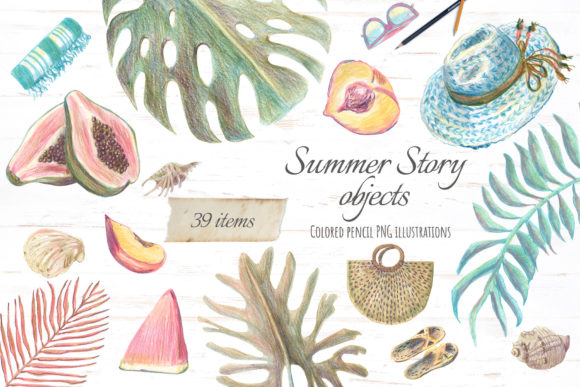
Summer Story. Objects: A Comprehensive Evaluation for Designers and Brand Owners
In the realm of graphic design, few seasonal themes are as versatile or as visually demanding as summer. It is a season defined by high contrast, vibrant colors, and specific cultural associations with travel, leisure, and nature. For professionals seeking to capture this essence without compromising on quality or originality, Summer Story. Objects presents a curated collection that bridges the gap between hand-drawn charm and technical precision. This article evaluates the utility, application, and comparative advantages of this asset set for various creative projects.
Understanding the Collection and Its Core Distinction
Summer Story. Objects is not merely a random assortment of clipart; it is a cohesive design system centered around the "taste of summer." The collection features 39 separate PNG files, each rendered at 300 dpi in RGB format with transparent backgrounds. This technical specification is critical for designers who require scalability without loss of resolution. Unlike vector-based assets that can sometimes feel sterile or overly geometric, these objects retain the organic imperfections of hand-drawn illustrations.
The distinctiveness of this set lies in its thematic focus on tropical elements—leaves, fruits, flowers, and vacation items. These are not generic icons but stylized representations designed to evoke a specific mood: warmth, relaxation, and natural beauty. The inclusion of transparent backgrounds allows for seamless integration into complex layouts, ensuring that the designer's background choices remain unobstructed. This level of preparation suggests a product designed for immediate use in professional workflows rather than simple hobbyist decoration.
Evaluating Use Cases Across Different Industries
The versatility of Summer Story. Objects makes it applicable across a broad spectrum of industries, from hospitality to retail. Understanding where these assets fit best requires an analysis of their visual weight and style compatibility.
Hospitality and Restaurant Branding
For the food and beverage sector, visual appeal is directly correlated with perceived value. The hand-drawn aesthetic of the Summer Story collection aligns perfectly with establishments aiming for an eco-friendly, artisanal, or farm-to-table image. The assets are explicitly noted for their suitability in:
- Eco-menu templates: The organic lines of the leaves and fruits soften the layout of a menu, making it feel approachable and sustainable.
- Restaurant decor and wall art: High-resolution files allow for large-format printing, turning digital assets into physical focal points.
- Packaging and price tags: The transparency ensures that branding elements do not clash with the texture of packaging materials.
When compared to stock photography, which often feels staged or over-produced, these illustrations offer a more authentic, story-driven approach. They suggest a narrative about the ingredients or the experience, which resonates well with modern consumers seeking authenticity.
Event Planning and Social Media
Events such as tropical parties, weddings, or beach-themed gatherings rely heavily on consistent visual language. The ability to match objects to create custom designs means that event planners can maintain a unified look across invitations, banners, and labels. The set supports the creation of cohesive invites and posters where the graphical elements (fruits, flowers) act as framing devices for text.
In the digital space, specifically for social media management, the 300 dpi resolution ensures that images look crisp on high-definition mobile screens. While many free clipart options degrade when scaled up, the quality of Summer Story. Objects maintains integrity, which is essential for brands trying to project professionalism on platforms like Instagram or Pinterest.
Comparative Analysis: Hand-Drawn vs. Vector and Stock Photography
When evaluating design resources, professionals typically choose between three categories: vector graphics, stock photography, and raster illustration sets like Summer Story. Objects. Each has distinct tradeoffs.
Vector Graphics offer infinite scalability and small file sizes, making them ideal for responsive web design. However, they often lack the texture and "human touch" that hand-drawn styles provide. If a brand wants a clean, corporate, or minimalist summer look, vectors are superior. But if the goal is to evoke nostalgia, warmth, or a rustic vibe, vectors can appear too rigid.
Stock Photography provides realism but comes with limitations regarding customization. Lighting conditions, composition, and model releases can restrict how an image is used. Furthermore, integrating photos into a layout often requires extensive masking and editing to remove backgrounds cleanly. In contrast, Summer Story. Objects arrives pre-masked with transparent backgrounds, saving hours of post-production time.
The strength of Summer Story. Objects sits in the middle ground. It offers the artistic flair of illustration with the technical convenience of pre-edited raster files. For users working in software like Illustrator, Photoshop, or Canva, this hybrid approach is highly efficient. The 300 dpi resolution ensures that while they are raster files, they possess enough detail for print applications, a common limitation of standard web clipart.
Technical Considerations and Workflow Integration
The practical utility of any design asset depends heavily on its compatibility with existing software ecosystems. This set is compatible with industry-standard tools including Adobe Illustrator, Adobe Photoshop, and Canva. This cross-platform compatibility is a significant advantage for freelancers and small business owners who may switch between programs depending on the task.
The RGB color mode is optimized for digital displays, which covers the majority of modern marketing needs. However, for print-heavy applications, designers should be aware that RGB differs from CMYK. While the 300 dpi resolution is excellent for print, converting RGB to CMYK during the printing process may result in slight color shifts. For most restaurant menus, party invitations, and digital banners, this is negligible. Yet, for large-scale outdoor banners requiring precise color matching, a conversion step might be necessary.
The inclusion of 39 separate files indicates a modular approach to design. Rather than receiving a single layered file, the user receives individual components. This modularity allows for greater creativity. A designer can isolate a single pineapple leaf to serve as a bullet point in a presentation, or combine a cluster of flowers with a fruit to create a unique logo mark. This flexibility encourages experimentation, allowing users to "create your own design" rather than being forced into a pre-set template.
Identifying Limitations and Decision Factors
No resource is perfect, and understanding the limitations of Summer Story. Objects is crucial for making an informed decision. The primary constraint is the file format. As PNGs, these files are raster-based. If a user attempts to scale them significantly beyond their native resolution for massive billboards, pixelation will occur. While 300 dpi is sufficient for most commercial print jobs (business cards, flyers, menus), it is not suitable for architectural-scale signage without upscaling software.
Additionally, the style is specific. The hand-drawn tropical theme is not a neutral design element. It will not work well for a luxury fashion brand, a tech startup, or a medical facility looking for a summer campaign. The aesthetic is inherently casual, playful, and nature-oriented. Users must evaluate whether this tone aligns with their brand voice before purchasing.
Furthermore, because the set relies on a specific color palette inherent to the drawings (greens, yellows, oranges, reds), users have less control over the base colors compared to vector files where every stroke can be recolored instantly. If a brand requires a strict monochromatic summer theme, this set might require additional editing to recolor the elements, which adds time to the workflow.
Strategic Recommendations for Selection
Deciding whether to utilize Summer Story. Objects depends on the specific goals of the project. This collection is the right choice when:
- Authenticity is key: You need visuals that feel crafted and human, avoiding the polished sterility of stock photos.
- Speed is essential: You need high-quality, transparent assets that save time on background removal and masking.
- Print quality matters: You require 300 dpi resolution for physical products like menus, tags, and packaging.
- Thematic consistency is required: You are building a campaign around tropical, beach, or garden themes and need a unified set of graphical elements.
Conversely, you may need another option if:
- You require editable vector paths for unlimited scaling.
- Your brand identity demands a strictly monochromatic or grayscale aesthetic.
- The project involves massive scale printing (e.g., vehicle wraps or building facades) where raster limitations would be problematic.
Conclusion on Value and Application
Summer Story. Objects represents a specialized tool for designers and brand managers looking to inject a sense of warmth and nature into their summer campaigns. By offering 39 high-resolution, hand-drawn assets with transparent backgrounds, it addresses the common pain points of sourcing consistent, high-quality imagery. While it lacks the infinite scalability of vectors, its balance of artistic character and technical readiness makes it a strong contender for restaurant decor, event planning, and eco-conscious branding.
Ultimately, the value of this set is found in its ability to streamline the design process. Instead of searching for disparate images that do not match in style or resolution, designers receive a cohesive library. Whether used for creating a custom logo, designing a promotional banner, or formatting a price tag, the collection provides a reliable foundation for building a compelling summer narrative. For those prioritizing visual storytelling and organic aesthetics, it serves as a robust resource that elevates the final output beyond standard clipart.