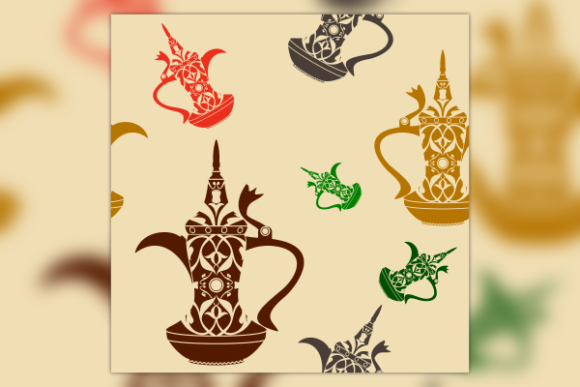
Dallah Arab Coffee Pot Seamless Pattern: A Digital Asset for Cultural Design
The Dallah Arab Coffee Pot Seamless Pattern represents a significant intersection between traditional Middle Eastern heritage and modern digital design workflows. This specific vector asset features flat monochrome style side-view illustrations of the iconic Arabian dallah, arranged in a continuous, repeating layout. Unlike static images that suffer from pixelation when scaled, this editable SVG vector allows designers to manipulate the pattern at any resolution without losing clarity. The collection includes various color variations, making it a versatile tool for professionals ranging from textile manufacturers to event planners.
At its core, the Dallah is more than just a vessel; it is a symbol of hospitality, generosity, and community in Islamic culture. By digitizing this motif into a seamless pattern, creators can infuse their projects with authentic cultural resonance. Whether used as a background for high-end fabric prints or as a subtle texture on digital invitations, the pattern bridges the gap between ancient tradition and contemporary aesthetics. The availability of source files in formats like EPS, PDF, and high-resolution PNG ensures compatibility across a wide array of software ecosystems.
Understanding the Visual Characteristics of the Pattern
The visual language of this asset is defined by its simplicity and geometric precision. The illustrations are rendered in a flat monochrome style, which strips away unnecessary shading and gradients to focus on the recognizable silhouette of the coffee pot. This side view captures the distinct long spout, the curved handle, and the rounded body that characterize the traditional Dallah. The seamless nature of the pattern means that the individual motifs tile perfectly horizontally and vertically, creating an infinite field of imagery.
Editability is a crucial characteristic of this digital product. Because the file is provided as an SVG (Scalable Vector Graphics), every element remains a distinct shape rather than a merged raster image. This allows users to change colors, adjust stroke weights, or rearrange the spacing between pots using vector editing software. The inclusion of multiple color variations within the ZIP archive further expands the creative possibilities, enabling designers to match specific brand guidelines or thematic requirements instantly.
- Silhouette Accuracy: The shapes adhere to the traditional proportions of the Arabian coffee pot, ensuring cultural authenticity.
- Flat Design Aesthetic: The absence of complex textures makes the pattern suitable for both minimalist and bold design approaches.
- Seamless Tiling: The edges align perfectly, allowing for use on large surfaces like wallpapers or full-roll fabrics.
Practical Applications Across Industries
The utility of the Dallah Arab Coffee Pot Seamless Pattern extends far beyond simple decoration. Its versatility allows it to serve functional roles in diverse sectors, from fashion to corporate branding. The ability to scale the pattern infinitely makes it particularly valuable for industries where print size varies significantly.
Textile and Fashion Design
In the world of textiles, patterns must be repeatable and durable. This seamless vector is ideal for creating prints on cotton, silk, or synthetic blends. Fashion designers can utilize the pattern to create abayas, scarves, or traditional thobes that celebrate heritage while maintaining a modern look. The flat style works exceptionally well with screen printing techniques, where distinct color separations are required. Furthermore, the pattern can be adapted for home decor items such as cushion covers, table runners, and curtains, bringing a touch of Arabian elegance to interior spaces.
Packaging and Merchandising
Brands looking to capitalize on the growing appreciation for Middle Eastern culture often seek packaging solutions that reflect this depth. The pattern serves as an excellent background for tea boxes, coffee tins, and gift sets. When printed on matte or textured paper stock, the monochrome elements provide a sophisticated contrast that elevates the perceived value of the product. Additionally, the asset is perfect for merchandise like tote bags, notebooks, and phone cases, offering a unique selling point for businesses targeting niche markets.
Digital Media and Web Design
For web developers and UI/UX designers, the SVG format offers immediate performance benefits. Because the pattern is vector-based, it loads quickly and scales crisply on retina displays and mobile devices. It can be used as a subtle background texture for landing pages, email newsletters, or social media banners. The ability to animate the pattern using CSS or JavaScript adds another layer of interactivity, perhaps by gently rotating the pots or changing their colors on hover to engage users.
Cultural Significance and Seasonal Relevance
Design is rarely neutral; it carries context. The Dallah holds a central place in the social fabric of the Arab world, representing the ritual of serving Arabic coffee. This ritual is most prominent during religious and social gatherings. Consequently, this pattern finds its most poignant application during specific times of the year, particularly in relation to Ramadan and Eid.
During Ramadan, the atmosphere shifts towards reflection, community, and hospitality. Invitations for Iftar dinners, banners for mosques, and promotional materials for iftar events benefit greatly from culturally resonant imagery. Using the Dallah Arab Coffee Pot Seamless Pattern signals respect for tradition and creates an immediate emotional connection with the audience. The pattern can be overlaid with calligraphy or combined with lantern motifs to create comprehensive seasonal designs.
Similarly, for Eid celebrations, the pattern can be adapted to festive color palettes. While the base vector is monochrome, the flexibility of the SVG allows designers to fill the pots with gold, deep greens, or rich burgundies to match the celebratory mood. Decorative elements for cafes, hotels, and restaurants during these periods often require large-scale applications, such as wall murals or floor graphics, where the seamless nature of the pattern is essential for avoiding visible seams.
Technical Workflow and Software Integration
To fully leverage the potential of this asset, understanding the technical workflow is necessary. The primary recommendation for editing this pattern is the use of Inkscape software. As a powerful open-source vector graphics editor, Inkscape provides robust tools for manipulating SVG files. Users can easily access the "Edit Paths" feature to modify the geometry of the Dallah or use the "Fill and Stroke" dialog to apply new color schemes globally.
The process typically involves importing the SVG file into the workspace. Once opened, the designer can select the entire pattern group and duplicate it to create custom layouts. If the user wishes to break the seamless repetition for a specific artistic effect, they can ungroup the elements and arrange them freely. For those who prefer Adobe Illustrator, the EPS and PDF versions included in the ZIP package ensure cross-platform compatibility, though the native SVG format offers the highest level of editability.
- Import: Open the SVG file in Inkscape or your preferred vector software.
- Analyze: Check the layers panel to understand how the pots are grouped.
- Modify: Select individual pots to change their fill color or stroke width.
- Scale: Resize the pattern to fit the intended output dimensions without quality loss.
- Export: Save the final design as a high-resolution PNG for raster-based printing or keep it as an SVG for web use.
Advantages of Vector Over Raster Formats
While many design assets are sold exclusively as JPEGs or bitmaps, the provision of EPS, PDF, and high-resolution PNG alongside the SVG offers a distinct advantage. Raster images are composed of pixels, meaning that enlarging them beyond their original dimensions results in blurriness or jagged edges. This limitation restricts their use to fixed sizes, such as small web thumbnails or standard business cards.
Vector formats, conversely, are mathematically defined. This means the Dallah Arab Coffee Pot Seamless Pattern can be expanded to cover the side of a building or shrunk down to fit onto a coin-sized badge without any degradation in quality. For professional printers, this is a critical requirement. Large format printing requires files that can handle massive scaling, and vector data ensures that the lines remain sharp and the colors remain solid. The inclusion of the high-resolution PNG also caters to workflows that do not support vectors, providing a fallback option that still maintains professional standards.
Considerations for Commercial Use
When integrating this pattern into commercial products, there are several factors to consider. First, the licensing terms associated with the asset should be reviewed to ensure compliance regarding resale rights. Second, the color profiles used in the design phase must match the printing method. For instance, designs created in RGB (for screens) will need to be converted to CMYK (for print) to avoid color shifts in the final physical product.
Furthermore, cultural sensitivity is paramount. While the Dallah is a widely recognized symbol, its representation should always be respectful. Using the pattern in contexts that might trivialize the significance of coffee in Arab culture could lead to negative reception. Therefore, the design intent should always align with themes of hospitality, celebration, and respect.
Future Trends in Cultural Motif Digitization
The demand for authentic cultural patterns in digital design is on the rise. Consumers and businesses alike are seeking ways to differentiate their brands through storytelling and heritage. The trend moves away from generic clip art toward bespoke, editable vector assets that allow for customization. The Dallah Arab Coffee Pot Seamless Pattern fits perfectly into this trajectory. It empowers creators to tell stories of the Middle East without relying on pre-made, rigid templates.
As 3D printing and augmented reality become more prevalent, the clean lines of the flat monochrome style will also find new life in three-dimensional modeling and AR overlays. The simplicity of the vector allows for easy extrusion or mapping onto 3D surfaces, opening up new avenues for interactive experiences. Educators and researchers studying material culture can also utilize these assets to visualize historical artifacts in a modern context, bridging the gap between academic study and public engagement.
Conclusion
The Dallah Arab Coffee Pot Seamless Pattern stands as a testament to the enduring power of traditional symbols in the digital age. By combining the rich heritage of the Arabian coffee pot with the flexibility of modern vector technology, this asset provides a valuable resource for a broad spectrum of users. From the hobbyist creating a birthday card to the professional manufacturer producing thousands of yards of fabric, the pattern offers a reliable, scalable, and culturally significant solution. Its adaptability to software like Inkscape, combined with the variety of output formats, ensures that it remains a relevant and useful tool for years to come.